Cells: The Building Blocks of Life
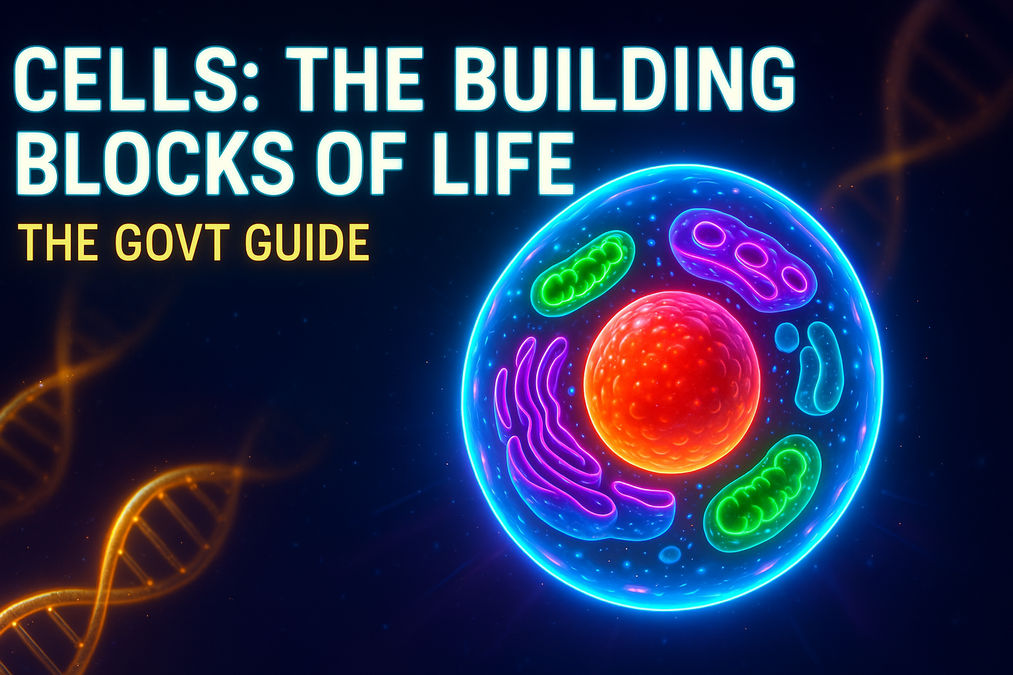
Cells: The Building Blocks of Life
Cells: The Building Blocks of Life
Cells are the fundamental units of life, serving as the structural and functional foundation for all living organisms. From microscopic bacteria to complex multicellular organisms like humans, cells are the essence of life itself. Often referred to as the "building blocks of life," cells perform critical functions such as metabolism, growth, reproduction, and maintaining homeostasis. This comprehensive guide, crafted for "The Govt Guide" readers, explores the intricate world of cells, their structure, types, organelles, and their significance in the grand tapestry of life.
The discovery of cells marked a pivotal moment in biology. In 1665, Robert Hooke, an English scientist, observed thin slices of cork under a primitive microscope and noticed tiny compartments resembling the cells of a monastery, thus naming them "cells." Since then, advancements in microscopy and molecular biology have unveiled the complexity and diversity of these microscopic marvels. Whether you're a student preparing for exams or a curious reader, this post will provide a detailed yet accessible understanding of cells.
Cell Theory: The Cornerstone of Biology
Cell theory is a foundational concept in biology, formalized in the 19th century by Matthias Schleiden and Theodor Schwann. Schleiden, a botanist, proposed that all plants are composed of cells, while Schwann, a zoologist, extended this idea to animals. In 1855, Rudolf Virchow added the critical insight that all cells arise from pre-existing cells, encapsulated in the Latin phrase "Omnis cellula e cellula" (all cells come from cells). This theory revolutionized our understanding of life and remains a cornerstone of modern biology.
The three main principles of cell theory are:
- All living organisms are composed of one or more cells.
- The cell is the basic unit of structure, function, and organization in all organisms.
- All cells arise from pre-existing cells through cell division.
Cell theory not only explains the unity of life but also highlights the continuity of life through cell division. It provides a framework for understanding how organisms grow, develop, and maintain their functions, from single-celled bacteria to complex multicellular organisms like humans.
Prokaryotic vs. Eukaryotic Cells
Cells are broadly classified into two types: prokaryotic and eukaryotic. Prokaryotic cells are simpler, lacking a true nucleus and membrane-bound organelles, while eukaryotic cells are more complex, with a defined nucleus and specialized organelles. The table below compares their key features:
| Feature | Prokaryotic Cells | Eukaryotic Cells |
|---|---|---|
| Nucleus | No true nucleus; DNA in nucleoid region | True nucleus with double membrane |
| Size | 0.1–5.0 μm | 10–100 μm |
| Organelles | No membrane-bound organelles | Membrane-bound organelles (e.g., mitochondria, ER) |
| DNA Structure | Single circular DNA, no histones | Multiple linear DNA with histones |
| Cell Division | Binary fission | Mitosis or meiosis |
| Examples | Bacteria, Archaea | Plants, Animals, Fungi, Protists |
Prokaryotic cells, such as bacteria, are typically unicellular and thrive in diverse environments, from soil to extreme conditions like hot springs. Eukaryotic cells, found in plants, animals, fungi, and protists, are larger and more complex, enabling specialized functions within multicellular organisms.
Cell Structure: A Detailed Exploration
Cells are like miniature factories, with specialized structures called organelles performing specific tasks. Prokaryotic cells have simpler structures, while eukaryotic cells contain a variety of complex organelles. Below, we explore key components of cell structure, focusing on their roles and composition.
Cell Wall: The Protective Shield
The cell wall is a rigid outer layer found in plant cells, fungi, bacteria, and some protists. It provides structural support, maintains cell shape, and protects against mechanical stress and pathogens. In plants, the cell wall is primarily composed of cellulose, a polysaccharide that gives rigidity. In bacteria, it’s made of peptidoglycan, while in fungi, it contains chitin. The cell wall also prevents excessive water uptake, which could cause the cell to burst.
There are two types of cell walls in plants:
- Primary Cell Wall: Flexible, formed during cell growth, allowing expansion.
- Secondary Cell Wall: Thicker, more rigid, deposited after growth for added strength.
Plasma Membrane: The Cellular Gatekeeper
The plasma membrane is a semi-permeable barrier that surrounds the cell, controlling the movement of substances in and out. It is composed of a phospholipid bilayer with hydrophilic heads and hydrophobic tails, embedded with proteins, cholesterol, and carbohydrates. The fluid mosaic model, proposed by S.J. Singer and G.L. Nicolson in 1972, describes the membrane as a dynamic structure with proteins floating in a fluid lipid bilayer. The membrane’s thickness ranges from 5 to 10 nanometers, and its composition varies (e.g., 52% protein and 40% lipid in human erythrocytes).
Cytoplasm: The Cellular Workspace
The cytoplasm is the gel-like substance inside the cell membrane, excluding the nucleus. It consists of cytosol (a water-based medium), organelles, and molecules like salts and enzymes. The cytoplasm is the site of many metabolic processes, including glycolysis and protein synthesis, and facilitates the movement of materials via cytoplasmic streaming.
Cell Envelope in Prokaryotes
In prokaryotic cells, particularly bacteria, the cell envelope is a complex three-layered structure comprising the glycocalyx, cell wall, and plasma membrane. The glycocalyx (a slime layer or capsule) protects against desiccation and immune attacks. The cell wall provides shape and prevents lysis, while the plasma membrane regulates substance transport.
Cell Organelles: The Functional Powerhouses
Organelles are specialized structures within eukaryotic cells that perform distinct functions, ensuring the cell’s survival and efficiency. They are divided into membrane-bound and non-membrane-bound categories.
Membrane-Bound Organelles
Membrane-bound organelles are enclosed by lipid membranes, allowing compartmentalization of functions. Key examples include:
- Nucleus: Discovered by Robert Brown in 1831, the nucleus is the control center, housing DNA within chromatin and a nucleolus for ribosome production. It regulates gene expression and cell division.
- Mitochondria: Known as the "powerhouse of the cell," mitochondria produce ATP through aerobic respiration. They have a double membrane, with the inner membrane folded into cristae, and contain their own circular DNA.
- Endoplasmic Reticulum (ER): A network of membranes, the ER includes rough ER (with ribosomes for protein synthesis) and smooth ER (for lipid synthesis and detoxification). Discovered by Porter and Thompson in 194Œ
- Golgi Apparatus: Identified by Camillo Golgi in 1898, it modifies, sorts, and packages proteins and lipids into vesicles for secretion or delivery.
- Lysosomes: Discovered by Christian de Duve in 1955, lysosomes contain hydrolytic enzymes that digest waste, old cell parts, and pathogens.
- Peroxisomes: These break down fatty acids and detoxify harmful substances like hydrogen peroxide.
- Vacuoles: Large in plant cells, vacuoles store nutrients, waste, and maintain turgor pressure.
- Plastids: Found in plant cells, plastids like chloroplasts (for photosynthesis), chromoplasts (for pigment storage), and leucoplasts (for starch/protein storage) perform specialized functions.
Non-Membrane-Bound Organelles
Non-membrane-bound organelles lack surrounding membranes and include:
- Ribosomes: Sites of protein synthesis, composed of rRNA and proteins, found free in the cytoplasm or on rough ER.
- Cytoskeleton: A network of microfilaments, intermediate filaments, and microtubules that provides structural support and aids in cell motility and division.
- Centrioles: Cylindrical structures that organize the mitotic spindle during cell division.
- Cilia and Flagella: Hair-like structures for movement or sweeping substances across cell surfaces.
Plant vs. Animal Cells
While both plant and animal cells are eukaryotic, they differ significantly. The table below summarizes the differences:
| Feature | Plant Cells | Animal Cells |
|---|---|---|
| Cell Wall | Present (cellulose) | Absent |
| Chloroplasts | Present (photosynthesis) | Absent |
| Vacuoles | Large central vacuole | Small, temporary vacuoles |
| Shape | Rectangular or box-like | Round or irregular |
| Centrioles | Generally absent | Present |
Plant cells are specialized for photosynthesis and structural support, while animal cells are more flexible and adapted for diverse functions like movement and signaling.
Key Questions and Answers
Q1: Who discovered the cell and how?
A1: Robert Hooke discovered the cell in 1665 by observing a cork slice under a microscope, noting its box-like structures.
Q2: What is the main difference between prokaryotic and eukaryotic cells?
A2: Prokaryotic cells lack a true nucleus and membrane-bound organelles, while eukaryotic cells have both, enabling complex functions.
Q3: What is the role of mitochondria?
A3: Mitochondria generate ATP through cellular respiration, serving as the cell’s energy powerhouse.
Frequently Asked Questions (FAQs)
Q1: What is a cell?
A1: A cell is the basic structural and functional unit of all living organisms.
Q2: Who discovered the cell?
A2: Robert Hooke discovered the cell in 1665 using a microscope.
Q3: What are the main types of cells?
A3: The two main types are prokaryotic (simple, no nucleus) and eukaryotic (complex, with a nucleus).
Q4: What is the function of the nucleus?
A4: The nucleus houses DNA and controls gene expression and cell division.
Q5: What do mitochondria do?
A5: Mitochondria produce ATP, the cell’s energy currency, via cellular respiration.
Q6: How do plant and animal cells differ?
A6: Plant cells have a cell wall, chloroplasts, and a large central vacuole; animal cells do not.
Q7: What is the plasma membrane?
A7: The plasma membrane is a semi-permeable barrier that regulates substance movement.
Q8: What is the cell wall made of in plants?
A8: In plants, the cell wall is primarily composed of cellulose.
Q9: What are organelles?
A9: Organelles are specialized structures within a cell that perform specific functions.
Q10: What is the endoplasmic reticulum’s role?
A10: The ER synthesizes proteins (rough ER) and lipids (smooth ER) and detoxifies substances.
Q11: What does the Golgi apparatus do?
A11: The Golgi apparatus modifies, sorts, and packages proteins and lipids for secretion.
Q12: What are lysosomes?
A12: Lysosomes are organelles containing enzymes that digest waste and cellular debris.
Q13: What is the cytoskeleton?
A13: The cytoskeleton is a network of protein filaments for structural support and transport.
Q14: Where are ribosomes located?
A14: Ribosomes, sites of protein synthesis, are found in the cytoplasm or on rough ER.
Q15: How do cells reproduce?
A15: Cells reproduce via mitosis (growth and repair) or meiosis (sexual reproduction).
Join the conversation